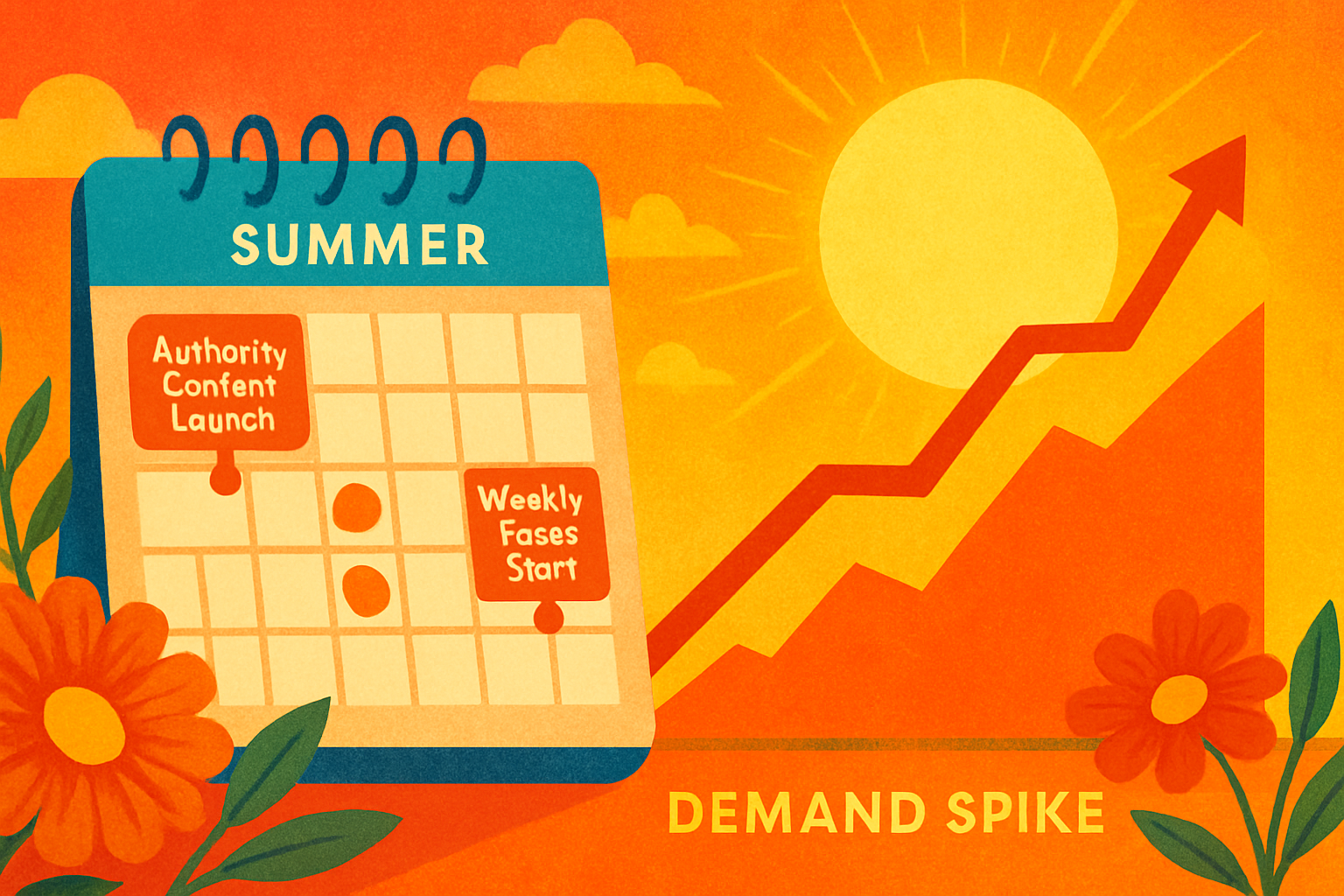
In Colorado Springs, a lot of service businesses wait until they are already busy to start marketing. By the time the first wave of summer calls hits, their competitors have already published the pages, answered the buyer questions, and built the search signals that get found first.
How can a local service business stand out before summer demand increases? Start summer business visibility preparation at least 6 to 10 weeks before peak season by publishing authority content, indexing service and location pages, and supporting those pages with weekly posts on your website, Google Business Profile, and social channels. That early publishing creates momentum before demand spikes, so your business shows up in search, local results, and AI answers while competitors are still catching up.
The businesses that win summer are already visible in spring
Summer rush season does not begin when the phone starts ringing. It begins when buyers start searching, comparing, and asking questions. In Colorado Springs, that often happens before the calendar says “summer” because homeowners, property managers, and commercial buyers want estimates, timelines, and availability before the heat, travel schedules, and project backlogs set in.
That is why summer business visibility preparation is less about “posting more” and more about making sure your expertise is already in market before demand rises. If your content appears only after your schedule fills up, you are publishing into the rush instead of preparing for it.
A readiness framework for Colorado Springs peak season operations
Think of readiness as a publishing timeline, not a marketing campaign. For Colorado Springs peak season operations, the goal is to establish authority before summer demand compresses everyone’s attention. The businesses that stand out are usually the ones that have already done four things: published a credible authority article, indexed the supporting pages that reinforce it, answered the most common buyer questions, and kept a steady cadence across channels.
8 to 10 weeks before peak demand: publish the main authority piece
This is where summer business visibility preparation starts. The core article should address the real buying concerns people have before they choose a provider: availability, response time, scope, pricing factors, project timelines, service area, and what makes one company easier to work with than another. For example, a landscaper might explain watering schedules, a roofer might explain storm inspection windows, and a cleaning company might explain how fast turnarounds work for short-term rentals or move-outs.
The point is not to sound promotional. The point is to be the answer that is already indexed when buyers begin comparing options.
6 to 8 weeks before peak demand: add supporting pages and service detail
After the primary authority article is live, reinforce it with service pages, location-specific pages, and supporting posts that answer narrower questions. This is where many local businesses fall behind. They have one homepage, a few thin service pages, and nothing else. That makes it hard for search engines and AI systems to understand what the business actually does, where it serves, and which problems it solves best.
Supporting pages should make your expertise easier to classify. If your main service is HVAC, supporting content might cover airflow issues in older homes, AC maintenance timing in dry climates, or how Colorado Springs temperature swings affect system load. If you are in pest control, the supporting posts might address seasonal entry points, prevention timing, or what homeowners should expect before an inspection. This is the kind of summer business visibility preparation that builds momentum instead of hoping one post will do everything.
Readiness indicators that your visibility is actually building
- Your main service pages are indexed and show up for branded and non-branded searches.
- Your Google Business Profile has fresh posts, service updates, and active Q&A support.
- Your content answers specific buyer questions, not just broad industry statements.
- Your business name appears consistently across website, social, and local profiles.
- Your articles and posts are published weekly, not only when there is downtime.
- Your content library includes seasonal topics tied to buying decisions in Colorado Springs, not generic national advice.
4 to 6 weeks before peak demand: distribute proof of expertise
Once authority content is published, momentum comes from repetition with relevance. Weekly supporting posts on your blog, Google Business Profile, and social channels help the market see that your business is active, available, and specific. This matters because consistent publishing separates experts from competitors who only show up when they remember to post.
For local buyers, consistency is a credibility signal. A company that published last week, answered a service question yesterday, and updated its profile this morning looks operationally ready. A company with a stale blog and no recent posts may still be good at the work, but it looks quiet.
In Colorado Springs, that visibility matters even more because buyers often compare providers across the Front Range and El Paso County before they call. If your content is already present in local search, on your Google Business Profile, and in AI answers, you are not just competing on price. You are competing on trust before the first conversation.
What content should answer before the summer rush starts
The best summer content does not chase trends. It answers the questions that slow down buying decisions. If a customer is asking them, your content should already be live.
Strong topics usually fall into a few practical categories:
Common mistake: publishing “seasonal” content that never helps someone choose
Many businesses create vague summer posts that say the season is busy, remind people to act early, and stop there. That does not build authority. Buyers need specifics: what should they ask for, what does good service look like, how far out should they book, what problems happen if they wait, and what makes one provider a better fit than another.
Useful content topics are the ones that reduce uncertainty. A buyer may search for “how far ahead should I schedule AC maintenance in Colorado Springs,” “what causes late-summer drainage issues,” “how to prepare a property for peak vacation rentals,” or “what should be included in a summer service estimate.” Those are not branding topics. They are buying questions.
That is where summer business visibility preparation pays off. The business that answers the question first often earns the call before the buyer finishes comparing three more options.
Myth: If we post more once summer starts, we can catch up quickly.
Reality: Content momentum takes time. Authority content, indexation, and repeated supporting posts build trust before the rush. By the time summer demand spikes, the businesses with an early publishing runway already have the search history and local signals working in their favor.
Why consistent publishing separates experts from competitors
Most competitors can say they are experienced. Fewer can prove it every week. That proof is visible in the content library, the Google Business Profile activity, the service pages, and the way the business answers customer questions in public.
For local service businesses, consistency does three things at once. It improves discoverability, because more pages and posts create more entry points. It improves credibility, because a steady cadence makes the business look active and reliable. And it improves conversion, because buyers see a company that already understands the problem they are trying to solve.
That is why “we’ll market when we get busy” is a weak plan. Once demand spikes, the window to build authority closes fast. The businesses that stand out in peak season are the ones that did their publishing before the phones started ringing.
How a local service business can stand out before summer demand increases
To stand out early, the business needs more than a few posts. It needs a publishing system that turns expertise into visible proof across search, local results, and AI-generated answers. That means authority content already in market, supporting pages that reinforce the topic, and steady distribution that keeps the business active in the places buyers check first.
In practical terms, this is what you want before peak season arrives: one strong authority article, multiple indexed supporting pages, recurring Google Business Profile posts, and weekly content that uses the business’s real voice. That combination is what makes a local service business look like the safer, more credible choice before the customer ever fills out a form or makes a call.
Byline's Insights
I always tell local businesses the same thing: if you wait until the schedule gets tight, you are no longer preparing for demand — you are trying to market from inside it. The best summer results usually come from content that was already live weeks earlier, because that gives search engines and buyers time to recognize the business as steady and specific. In my experience, the companies that publish consistently look like they run a tighter operation, even before someone hires them.
Frequently Asked Questions
How early should a local service business start summer business visibility preparation?
Start 6 to 10 weeks before peak demand. That gives authority content time to index and gives supporting posts time to reinforce your presence before buyers start making faster decisions.
Does one article really make a difference?
Yes, if it is the start of a larger content system. One strong article can anchor a cluster of supporting pages, Google Business Profile posts, and social distribution that together improve visibility.
What should Colorado Springs businesses publish before summer?
Publish content that answers pricing, timing, availability, service area, and seasonal problem questions. Focus on what buyers need to know before they call, not broad educational content with no buying intent.
How does publishing help with AI search and local search?
Consistent publishing gives search and AI systems more clear, current signals about what you do, where you work, and why you are credible. That increases the chance your business appears in answers and local discovery.
Build your summer visibility before the rush begins
If your business is still waiting to market until things get busy, the opportunity is already moving past you. postedby.ai helps local service businesses turn expertise into weekly authority content, indexed pages, and consistent multi-channel publishing that supports real summer business visibility preparation.
See how postedby.ai can help you be the source AI cites.